
Skip five years of development roadblocks and launch on a mature engine built from real operating experience.
10200+ jobs completed
35400+ members
5+ yrs Operating
Build your marketplace on the Ezy Peazy Marketplace Engine—a white-label marketplace platform for founders and operators launching local services marketplaces in non-competing markets.
Whether you're searching for an Airtasker clone, TaskRabbit clone, Thumbtack clone, or similar marketplace software, don't settle for a basic clone script. Most clone scripts provide little more than front-end screens. They lack the operational workflows, trust systems, moderation tools, SEO architecture, and marketplace logic needed to run a real local services marketplace.
The Ezy Peazy Marketplace Engine has been refined through 10200+ completed jobs on a live New Zealand marketplace over more than five years. Every operational challenge we've solved and every feature we've built has shaped the platform you'll launch on.
Unlike a static clone script, this is a living marketplace engine. As we continue improving Ezy Peazy, your platform benefits from the same product enhancements, security updates, and operational refinements. You don't just launch on a mature platform—you continue growing with one.
Skip years of custom software development and start with a proven marketplace foundation, so you can focus on what really matters: attracting customers, onboarding quality workers, building trust, growing through organic search, and scaling your business.
10200+
Completed jobs
35400+
Registered members
5+ yrs
Operating in local services
NZD $1.8M+
Gross marketplace volume
You can build the features and still miss the operating logic.
A good development team can build the visible parts of a local services marketplace: Task posting, worker profiles, Offers, Reviews, Messaging, Payments, and Admin screens. But those are only the surface-level features. The real marketplace nightmares start when live users behave in ways you never anticipated.
Before you spend $50k+ hiring developers, ask yourself how your codebase will handle these hidden operational traps:
Let’s say you have 50 active workers and decent liquidity. If a customer posts a high-value renovation or landscaping job worth $5,000, do you really think the traditional flow — worker makes an offer, customer clicks accept, platform takes a cut — will work smoothly?
Underquoting is not just a pricing issue. It affects customer expectations, worker trust, job quality, and platform reputation.
If one worker quotes unrealistically low prices, the customer may treat that as the “real” price. Then better workers look expensive, even when their pricing is more realistic.
Have you thought about how to detect underquotes, discourage bad pricing behaviour, and possibly use reputed workers or internal moderators to help set reasonable price expectations?
Low-quality workers may send offers everywhere just to win something. They underquote, copy-paste messages, waste customer attention, and make serious workers feel like the platform is becoming a race to the bottom.
How will you protect your best workers’ time?
How will you decide who gets unlimited access and who should be restricted before they damage trust?
Most founders think more workers means better supply. That is not always true. Bad supply can be worse than no supply.
If low-quality workers join early, they can no-show, underquote, communicate poorly, threaten customers, or create safety concerns. One bad worker experience can damage the brand more than ten good jobs can repair.
What is your first line of defence before they even start making offers?
For a local services marketplace, SEO is not just “write blogs.”
Your category service pages, city pages, completed job pages, workers profile, internal links, URL structure, and content strategy need to be planned from day one.
If you get this wrong, you can create cannibalisation, thin pages, crawl waste, duplicate content, and weak organic growth. And this is where many founders underestimate the problem.
We learned this the hard way at Ezy Peazy. A wrong SEO architecture decision can seriously hurt a marketplace’s visibility, trust signals, and growth. We wrote about this in our marketplace SEO case study here: How We Accidentally Killed Our Organic Traffic
Have you thought through marketplace SEO deeply enough to build the architecture correctly before development starts?.
Users will share phone numbers, emails, addresses, URLs, payment instructions, and off-platform requests.
Some will do it intentionally.
Some will do it accidentally.
Manual monitoring will not be enough. You need automated detection, AI-assisted moderation, manual review, and community reporting. Otherwise, your marketplace can leak value, create safety risks, and lose control of the transaction.
If these questions feel uncomfortable, that is exactly the point.
The reality of B2C local services
A mature, profitable platform must be built around actual user behavior. We spent 5+ years and over half a million in R&D to figure out these edge cases so you don't have to.
You bring the market. We provide the fully configured white-label marketplace infrastructure under your own brand.
A customer-facing platform configured with your brand, domain, service categories, locations, and marketplace structure.
A task posting flow that helps customers describe what they need, submit jobs, receive offers, communicate with workers, and complete work through the platform.
A worker flow for registration, profiles, service selection, offers, communication, reviews, and marketplace activity.
Integrated payment workflows, giving you absolute control over platform service fees, transaction processing, and automated escrow payouts upon job completion.
Tools to manage users, jobs, offers, worker profiles, reviews, content, moderation, warnings, bans, and day-to-day marketplace operations.
Marketplace rules and controls designed to help you manage worker quality, reduce poor behaviour, limit risky activity, and protect the customer experience.
Push notification, email, and SMS-ready communication flows so customers and workers do not rely on email alone for important marketplace activity.
A marketplace structure designed to support service pages, city pages, completed job proof, internal linking, and long-term organic growth.
Optional AI workflows to help improve vague customer task descriptions, detect missing information, and make jobs clearer for workers to quote.
Tracking foundations to help you understand where customers drop off, how users move through the platform, and which parts of the marketplace need improvement.
Guidance on how to approach early supply, demand, categories, locations, worker onboarding, admin operations, and marketplace quality.
Google Ads setup, Google Ads management, SEO consulting, growth strategy, and deeper founder mentorship can be discussed separately.
You get the platform, setup, support and playbook - without managing the codebase.
Marketplace Launch Kit is offered as a hosted white-label platform. You do not need to hire a full product and engineering team from day one just to build and manage the basic marketplace foundation. You can focus entirely on the harder early-stage work of growing the marketplace.
OPERATIONAL MATRIX
WE PROVIDE
We provide fortnightly founder strategy calls during the setup and early launch phase to guide you on marketplace operations, customer acquisition, SEO priorities, and common marketplace mistakes to avoid.
YOU HANDLE
You come prepared with updates, questions, local market learnings, and decisions that need your local judgement. You are responsible for executing the local growth and operations plan.
WE PROVIDE
We provision and maintain the core hosting environment, database architecture, security setup, deployment process, and platform monitoring.
YOU HANDLE
You pay variable hosting and usage costs where applicable, including cloud usage, storage, bandwidth, and domain renewal.
WE PROVIDE
We provide the core marketplace system: posting flow, tasker flow, offers, reviews, admin controls, moderation tools, SEO structure, and operating logic.
YOU HANDLE
You define your local marketplace rules, service categories, locations, launch focus, pricing approach, and day-to-day operating decisions.
WE PROVIDE
We provide the platform architecture for payment routing, fee deduction, and marketplace transaction workflows where supported.
YOU HANDLE
You set up and manage your own payment accounts, local fees, refunds, chargebacks, tax obligations, and financial/legal compliance.
WE PROVIDE
We provide system-level checks to help detect phone numbers, emails, URLs, suspicious wording, and off-platform transaction attempts.
YOU HANDLE
You review flagged content, make local judgement calls, manage repeat offenders, and enforce your marketplace rules.
WE PROVIDE
We provide trust levels, badge logic, warning/strike tools, account restrictions, identity-verification result visibility, and admin controls.
YOU HANDLE
You approve workers, review portfolios, validate local licences or IDs, handle failed verification reviews, and remove unsafe or low-quality users.
WE PROVIDE
We provide admin tools to edit tasks, offers, comments, profiles, users, credits, refunds, announcements, redirects, cache, and IP blocks where applicable.
YOU HANDLE
You operate the admin panel, respond to local issues, manage disputes, support users, and keep your marketplace healthy.
WE PROVIDE
We provide the technical SEO foundation: category/city/service structure, programmatic URL logic, completed-job proof structure, redirects, and internal linking framework.
YOU HANDLE
You create unique local content, hire local writers, do regional keyword research, publish blogs, and avoid copying Ezy Peazy’s live content/assets.
WE PROVIDE
We provide layout skeletons and starter structures for key pages such as How It Works, FAQs, category templates, and marketplace explanation pages.
YOU HANDLE
You rewrite and localise the content for your market, language, tone, legal requirements, and audience.
WE PROVIDE
We monitor the platform and handle core platform emergencies, infrastructure-level issues, and critical system failures.
YOU HANDLE
You report local issues, monitor third-party service outages, and submit non-critical bugs through the support process.
WE PROVIDE
We provide the technical support framework, admin visibility, communication logs, and issue-handling tools.
YOU HANDLE
You answer customer/tasker queries, manage local disputes, resolve pricing disagreements, and handle day-to-day marketplace support.
WE PROVIDE
We provide integration hooks for system emails, SMS notifications, and relevant communication workflows.
YOU HANDLE
You create and maintain your own third-party accounts such as email/SMS providers and pay message usage costs directly.
WE PROVIDE
We provide tracking foundations and reporting visibility for marketplace activity, user behaviour, task flow, and key platform events.
YOU HANDLE
You review the data, make business decisions, track local performance, and decide where to grow supply and demand.
WE PROVIDE
We provide guidance, marketplace experience, and optional consulting around launch strategy, SEO, and paid growth.
YOU HANDLE
You run your local marketing, paid ads, partnerships, content production, tasker onboarding, and customer acquisition.
WE PROVIDE
We continue improving the core Ezy Peazy Marketplace Engine and roll relevant improvements into your white-label version.
YOU HANDLE
Market-specific features, custom workflows, unusual integrations, and major design changes are quoted separately.
WE PROVIDE
We provide platform-level workflows such as consent checkboxes, data request hooks, and account-control systems where applicable.
YOU HANDLE
You are responsible for local legal advice, Terms of Service, Privacy Policy, tax rules, worker classification, payment regulations, and business liability.
WE PROVIDE
If added later, we can provide separate iOS/Android app deployment, branding, app builds, store submission support, and app maintenance.
YOU HANDLE
You pay the separate app setup fee, app maintenance fee, developer account fees, and should first build real web marketplace activity before launching apps.
WE PROVIDE
We maintain the core platform and shared engine improvements.
YOU HANDLE
You own your local brand, user base, marketplace content, customer relationships, and operational data, subject to the final agreement.
This division keeps the model clear: we help you avoid building the software from scratch while you focus on building the marketplace in your own market.
We won’t just hand you a platform and disappear. As part of the setup, we train your team on the admin tools, guide you through the operational requirements, and help you understand what needs to be handled locally. You run the market — but you do not start from zero. We want you to succeed, because your success means the engine is doing what it was built to do: helping serious operators build real local services marketplaces.
If you believe that launching a marketplace website built for $2k-$5k will be enough to create traction, raise funding, and build a serious local services business, the Marketplace Launch Kit is not the right fit. We have seen funded startups in this space fail because they treated product development too lightly and assumed a basic website or app would be enough, and that marketing would solve the rest. It rarely works that way.
A local services marketplace needs more than launch screens. It needs supply, demand, trust, liquidity, worker quality, admin control, fast communication, moderation, SEO structure, and constant product improvement. Category leaders such as AirTasker and TaskRabbit did not grow simply because they launched a basic app. They had serious operators, strong product focus, capital, timing, and the ability to keep investing in both growth and product development. That is the reality.
Marketplace Launch Kit is for serious founders and operators who understand that the platform foundation matters and that building the market still takes real work.
Marketplace Launch Kit is not a self-serve template or a basic clone script. We work with selected founders and operators because every local services marketplace needs to be configured around its unique market variables.
01
Tell us what you want to build, where you want to launch, which services you want to support, and how you plan to bring in customers and workers. We review whether your market, model, and timing are a good fit, and ensure your market does not directly compete with Ezy Peazy in New Zealand.
02
If the idea looks suitable, we discuss your launch plan in more detail. This includes your target city or region, first service categories, supply plan, demand plan, budget, team, and whether you are building a broad marketplace or a focused vertical. The goal is to make sure you are not trying to launch too wide, too early.
03
Once we move ahead, we configure the Ezy Peazy Marketplace Engine for your brand and market. You get access to the platform foundation we have built for Ezy Peazy over 5+ years, adapted for your own marketplace.
This includes your brand and domain, locations, service categories, customer flow, worker onboarding flow, the Stripe-backed escrow offer system, admin controls, communication workflows, analytics setup, SEO structure, moderation tools, trust systems, and marketplace rules. You are starting from a marketplace foundation built through real local services experience.
04
Before launch, we walk you through how to operate the marketplace. This includes how to manage customers, workers, offers, moderation, admin actions, worker quality, early liquidity, and marketplace controls. The goal is not just to show you which buttons to click; it is to help you understand how the platform should be used to manage real marketplace behaviour.
05
Once the foundation is ready, you start bringing in customers and workers. We support the platform while you focus on the real growth work.
As we continue improving Ezy Peazy, relevant platform improvements are added to your white-label marketplace over time. You benefit from ongoing marketplace learning, product improvements, and operational upgrades as the core platform keeps evolving.
Marketplace Launch Kit is built for founders and operators who are serious about launching and growing a real local services marketplace. This is not a $5,000 clone script or a basic marketplace template.
You are getting a white-label marketplace foundation based on what we have built for Ezy Peazy over 5+ years, along with setup, configuration, training, ongoing development support, and marketplace guidance.
USD $20,000–$35,000
one-time
Matches Ezy Peazy
Custom build
A mobile-responsive web platform with the core Ezy Peazy Marketplace Engine configured for:
Your brand
Your market
Your locations
Your service categories
Customer flow
Worker flow
Admin controls
SEO structure
Moderation workflows
Analytics setup
The closer your marketplace is to the existing Ezy Peazy model, the closer your setup is likely to be to the lower end of the price range. If your model needs heavier configuration, unusual workflows, extra integrations, or deeper marketplace changes, the setup cost moves toward the higher end or is quoted separately.
USD $1,500–$2,500
/month
Ongoing support includes:
Platform access
Core maintenance
Bug fixes
Deployment support
Technical improvements
Relevant updates we continue building into the Marketplace Engine
Custom features, major design changes, unusual integrations, and market-specific development are scoped separately.
USD $15,000–$25,000
one-time
Matches Ezy Peazy
Custom build
The app add-on includes:
iOS and Android apps
Follows the existing Ezy Peazy app structure
Connects to the same marketplace engine
Heavy customisation, custom journeys, or new native features quoted separately
The app add-on starts from USD $15,000 when the apps follow the existing Ezy Peazy app structure closely and connect to the same marketplace engine.
If you need heavy app customisation, custom user journeys, new native features, separate customer and worker app experiences, or major design changes, the app package is quoted separately.
USD $1,000–$1,500
/month
Native apps need ongoing:
App store submission support
OS compatibility updates
Dependency updates
Push notification maintenance
Crash fixes
Release management
Ongoing testing across iOS and Android
They need app store submission support, operating system compatibility updates, dependency updates, push notification maintenance, crash fixes, release management, and ongoing testing across iOS and Android.
For this reason, native apps include an additional monthly support cost.
The exact amount depends on app complexity, user activity, required updates, and the level of support needed.
The more your marketplace follows the existing Ezy Peazy operating model, the less custom work is needed. That keeps your setup cost lower. The more your marketplace needs custom workflows, integrations, design changes, or market-specific product changes, the more setup and support it requires.
Our goal is simple: help you launch on a mature marketplace foundation, keep your product improving over time, and let you focus on building the business, not managing software development from scratch.
It is built exactly for you. If you are a non-technical founder, your biggest operational risk is burning $100,000+ on unreliable custom development agencies, only to end up with a prototype that has no real market experience. This engine completely eliminates that liability, handing you the same feature depth, security infrastructure, and algorithmic routing power as a massive tech company, so you can focus 100% of your energy on execution, marketing, and growth.
$100,000+
Typical cost of an unreliable custom development, with a prototype that has no real market experience.
Day one
Feature depth, security infrastructure, and routing power of a mature platform, from the start
When you launch with us, you are not just buying software code; you are acquiring an active operational partner to safeguard your growth:
Direct, bi-weekly alignment sessions to review your local roadmap and ensure you steer clear of the exact operational traps and costly mistakes Ezy Peazy made in its early days.
Seamless platform updates and ongoing feature refinements, funded directly by your predictable monthly management retainer.
Constant technical oversight to isolate, patch, and resolve platform anomalies before they affect your users.
Dedicated architecture monitoring to keep your platform optimised against changing search dynamics as LLMs and AI search engines alter the web visibility landscape.
Direct strategic support for configuring and scaling targeted Google Ads and Meta campaigns (separate management budget) to rapidly inject initial customer supply and worker demand into your ecosystem.
You can.
There are ready-made marketplace scripts and clone platforms that give you task posting, bidding, profiles, payments, admin screens, and even source code. If your goal is simply to launch a marketplace-looking website for the lowest possible cost, those options may be enough.
But a local services marketplace does not succeed because the screens exist.
It succeeds when customers get quality responses, workers behave reliably, pricing makes sense, admin can control problems quickly, SEO is built correctly, and liquidity grows category by category.
Marketplace Launch Kit is not positioned against cheap scripts. It is for founders who understand that the visible product is only the beginning, and that marketplace operating logic is what usually takes years to learn.
APPLICATION FORM
Marketplace Launch Kit is built for serious founders and operators.
Please share a few details so we can understand whether your market, model, and timing are a good fit.
Contact & project basics
Marketplace strategy
Market readiness & capital
Name
Company / project name (Optional)
Target launch country & cities
Don't take our word for it.
Take these two screenshots and the technical checklist below to any senior full-stack developer, software architect, or reputable development agency you are considering hiring. Show them what is pre-engineered into the Ezy Peazy engine out of the box, and ask them two simple questions:
1
2
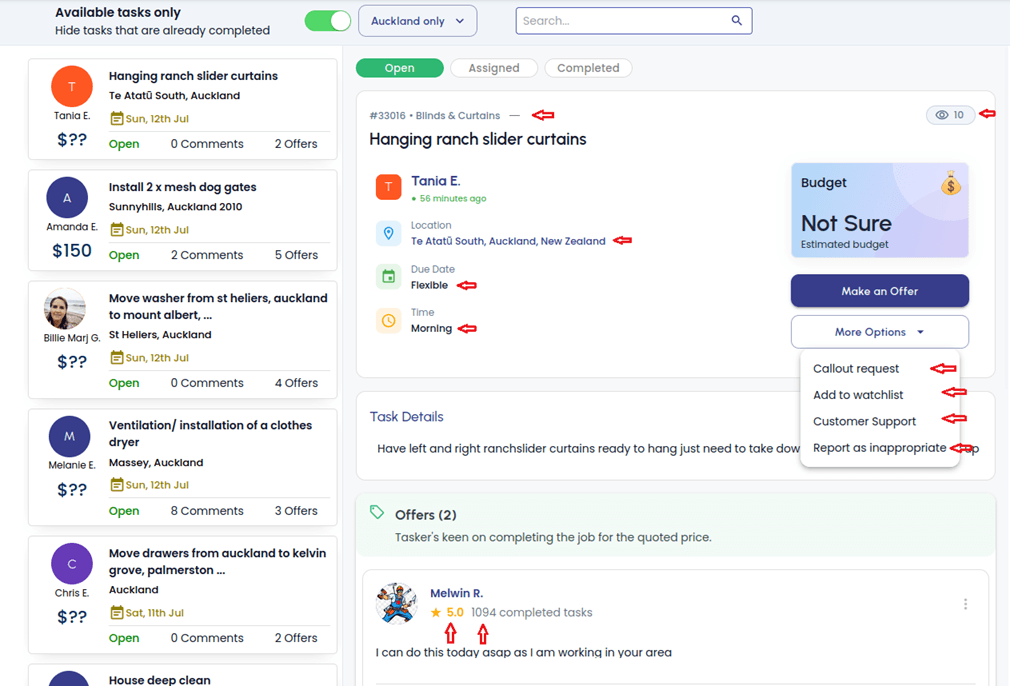
The live workspace view tracking live view counts, deep-linked mapping, conditional poster schedules, 1,000+ curated sub-categories, and rolling worker reputation algorithms.
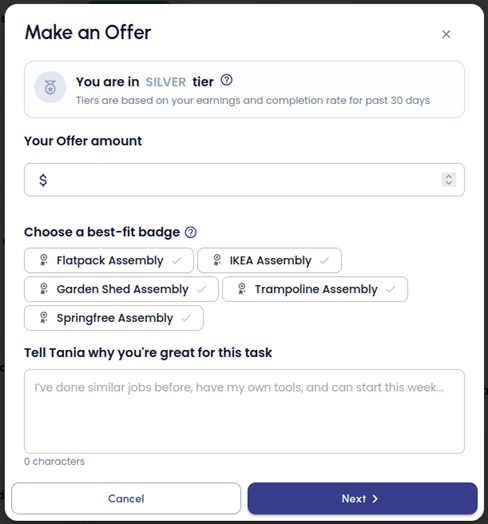
Advanced bidding terminal displaying dynamic 30-day performance tiering, task-specific custom skill badge selectors, and time-decaying custom offer expiry limits.
CORE ENGINE SPECS
Automated database cron jobs that continuously calculate every worker’s completion rates and earnings to shift them between platform fee tiers dynamically.
Systemic ticketing pipelines that hard-link user messages and multi-target fraud/underquote reports directly to specific task objects so the admin panel is never blind.
Relational database logic that scans a worker’s profile and dynamically surfaces only their relevant, approved certifications based on the exact task category viewed.
Algorithmic regex and pattern-matching systems that catch off-platform transaction leaks (phone numbers, email variants, external banking phrases) and route them to an invisible administrative moderation queue.
Relational database systems mapping over 1,000 manually structured sub-categories, permitting single-click watchlist additions or removals straight from active task feeds.
Location API coordinate mapping that converts text addresses into clickable links, automatically launching external device mapping systems.
Advanced data logic processing varied customer availability constraints, balancing completely flexible dates against specific time-of-day preferences.
Heavy database calculation pipelines tracking worker fulfillment metrics, dynamically calculating average review ratings based strictly on the last 10 completed jobs.
Real-time data sync engines tracking, validating, and displaying aggregate completed task counts across massive individual user transaction histories.
Automated time-sensitive scheduling architecture that systematically deprecates and revokes active bids based on custom worker-defined expiration limits.
what any experienced developer will tell you, looking at this list
Building just these micro-interactions from scratch requires months of data engineering, background processing logic, and edge-case QA testing. For a fraction of the cost of their development runway, you can launch on a mature engine in 4 to 12 weeks and spend your capital where it matters: acquiring customers and building local market liquidity.
Stop guessing. Apply to launch your marketplace engine.